Note: Internal combustion engine on these generators produce carbon monoxide which is an extremely toxic gas. Use at your own risk.
Connecting a small portable generator to the boat shore power plug can be a convenient way to power your boat when shore power is not available. Here are the steps to connect a small portable generator to the boat shore power plug:
- Make sure that your boat is turned off and disconnected from shore power before connecting the generator.
- Locate the shore power inlet on your boat. It is typically located on the transom or on the side of the boat near the shore power pedestal.
- Obtain a shore power cord that matches the type of shore power inlet on your boat. The shore power cord should have a male plug on one end and a female receptacle on the other end.
- Connect the male plug of the shore power cord to the generator’s output receptacle.
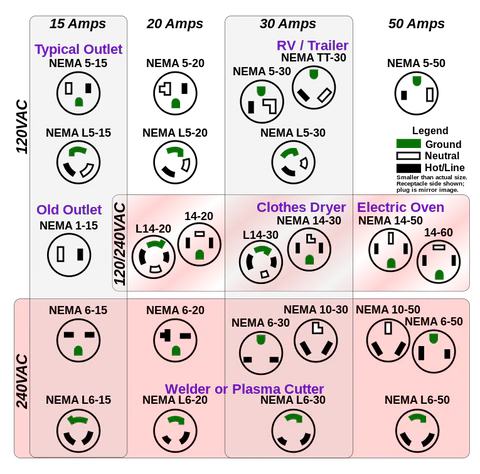
You may require a ABN 15A to 30A RV power cord converter. Some gensets come with a NEMA RV30 outlet in which case the converter plug could be NEMA TT-30 to Female SS2-50R. Match your house plug to the NEMA chart below. - Connect the female receptacle of the shore power cord to the boat’s shore power inlet.
- Start the generator and allow it to warm up before turning on any electrical appliances or systems on the boat.
- Once the generator is running smoothly, you can turn on the electrical appliances and systems on the boat as needed.
- Monitor Carbon Monoxide (CO) levels in any enclosed space. This by product of combustion is heavier than air, will accumulate in low levels within the cabin and is extremely toxic. Even low levels of CO are dangerous and can cause death within minutes. NEVER place a generator in a cabin or near hatches/portholes or any opening which would allow ingress of exhaust gases into the living spaces.
Note: It is important to make sure that the generator is rated for the electrical load that you will be placing on it, and that it is properly grounded to avoid any potential electrical hazards.
NEMA Plug Chart:
Determining the Size of Generator Required
When calculating the generator size you need, you should use the rated power of the generator. The rated power is the maximum power output that the generator can sustain for an extended period of time without overheating or causing damage to the engine. It is the power output that is typically advertised by the manufacturer and used to determine the generator’s capacity.
Peak power, also known as surge power, is the maximum power output that the generator can produce for a short period of time, typically a few seconds, to handle starting loads or inrush currents of electric motors, compressors, or other equipment. This extra power is useful to prevent overload or voltage drop during the starting process, but it is not a sustained power output.
Using the rated power of the generator to calculate the generator size you need ensures that the generator can continuously supply the required power for the duration you need, whether it’s for emergency backup, recreational use, or industrial purposes. It’s important to choose a generator that has enough rated power to meet your needs and to avoid overloading the generator, which can damage the equipment, cause electrical hazards, or affect the quality of the power output.
Calculating Power Use:
(Assuming you have a generator rated for 2200 watts)
To determine the number of amps a 2200 watt generator can support, you need to use the formula:
Amps = Watts / Volts
Assuming a standard voltage of 120 volts for household appliances in the US, the calculation would be:
2200 watts / 120 volts = 18.33 amps
Therefore, a 2200 watt generator can support up to 18.33 amps at 120 volts. It’s worth noting that the maximum amount of amperage that the generator can support will also depend on the specific model and its design. Additionally, it’s important to properly manage the electrical load placed on the generator to prevent overloading and potential damage to the unit or connected appliances.
Hazards of Using a Small Portable Generator on a Boat
Using a small portable generator on a boat can pose a hazard of carbon monoxide (CO) poisoning if not used properly. To avoid the hazard of CO when using a small portable generator on a boat, here are some steps that you should follow:
- Always use the generator in a well-ventilated area. Avoid using it in enclosed spaces such as the cabin or below deck.
- Install CO detectors in the cabin and living areas of the boat. Make sure they are in working order and properly maintained.
- Never run the generator while the boat is in motion or while swimming around the boat.
- Make sure the exhaust pipe is directed away from the boat and any living spaces.
- Do not sleep or spend extended periods of time in the same area as the generator while it is running.
- Follow the manufacturer’s instructions for starting and stopping the generator. Never modify the generator or its exhaust system.
- Turn off the generator and allow it to cool down before refueling. Gasoline and other fuel vapors can ignite and cause a fire or explosion.
- Always have a fire extinguisher on board and readily available in case of emergency.
By following these steps, you can reduce the risk of CO poisoning and enjoy the convenience of using a small portable generator on your boat safely.
We do not endorse nor recommend the use of any internal combustion engine on a boat. If you wish to use one, you do so at your own risk. We highly recommend that any installation is done by an accredited and professional service company.